If you are drawn to clean lines, glass-filled rooms, and wide Atlantic views, Truro offers a version of modern living that feels distinctly Cape Cod. Here, design is not just about style. It is about how a home meets wind, dune, floodplain, topography, and light. If you are exploring a modern or oceanview property in Truro, understanding that balance can help you make a smarter and more confident decision. Let’s dive in.
Why Truro modernism feels different
Truro is not a place where modern architecture usually shows up as oversized spectacle. Much of the town is shaped by the protected landscape of Cape Cod National Seashore, which covers a large share of the outer Cape and helped define Truro as a low-density, resort-oriented community with many second homes.
That setting changes the conversation around design. In Truro, a modern home is often valued for restraint, siting, and connection to the landscape rather than raw square footage. Ocean light, dune contours, and the need to build carefully all influence what modern architecture looks like here.
A landscape that shapes every home
The coastal environment in Truro is dynamic. Shoreline change, tidal patterns, groundwater conditions, and rising sea level continue to affect the broader landscape, and local history offers visible examples of that reality. Highland Light, for instance, was moved 450 feet inland to safer ground because of erosion.
That is one reason oceanview living here comes with a different mindset. You are not just buying a view. You are buying into a place where design decisions often need to respond to long-term coastal change.
What modern architecture means in Truro
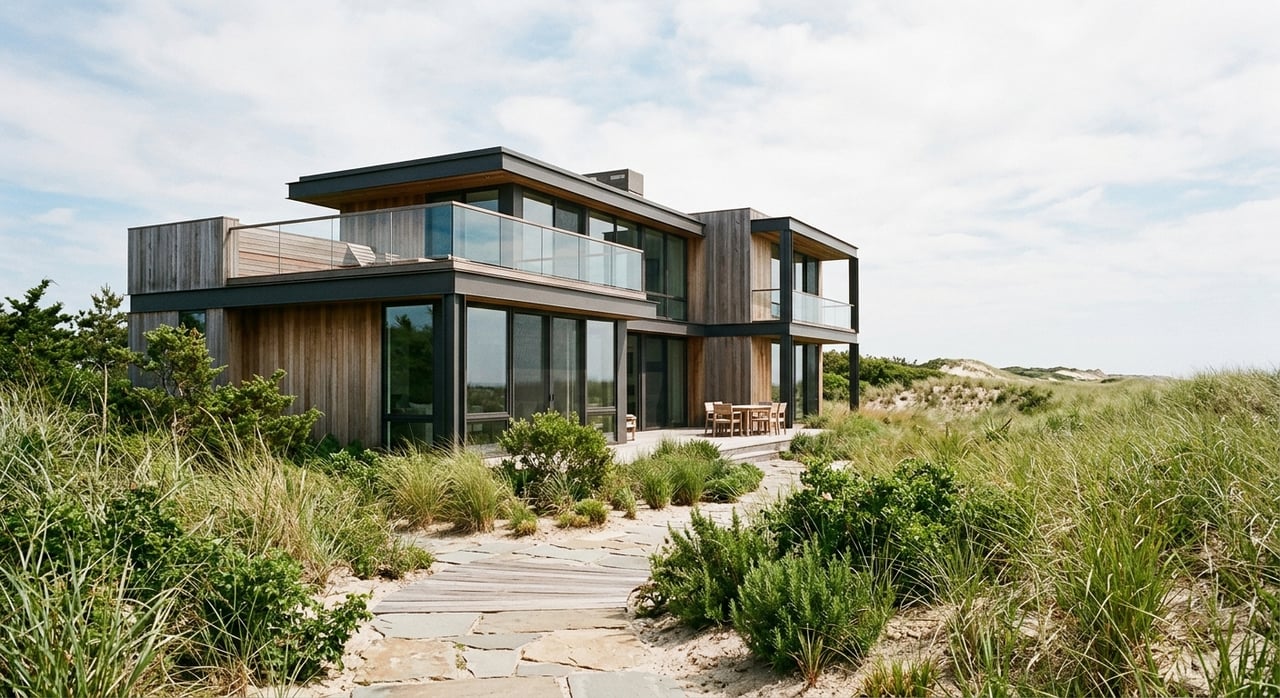
In Truro, the most successful modern homes tend to be contemporary in form but coastal in behavior. That usually means homes that welcome natural light, frame water views, and feel visually calm, while also keeping massing modest and fitting the terrain.
You may see design features such as:
- Simple, low-profile forms
- Large windows placed to capture light and outlooks
- Elevated living areas in flood-prone settings
- Natural materials and muted palettes that blend with the site
- Site plans that minimize grading and preserve existing vegetation
This approach reflects local review standards. Truro’s planning and conservation framework emphasizes fitting the land, preserving natural landscape features, and limiting unnecessary disturbance.
Modern does not mean detached from place
That point matters in a town with strong preservation and open-space values. Truro includes historic and fragile landscapes, from the windswept Truro Highlands area to dune environments shaped by movement and exposure.
For buyers, that means the best modern homes here often feel grounded rather than flashy. They are designed to sit lightly on the land and make the view feel earned, not imposed.
Oceanview living comes with real site questions
An oceanview can be the headline feature of a Truro property, but the site details are often just as important as the architecture. Local zoning and environmental review can affect where a home sits, how high it rises, and what future changes may be possible.
Truro’s residential zoning generally includes a minimum lot size of 33,750 square feet, 150 feet of frontage, 25-foot front, side, and rear setbacks, and a height cap of 30 feet for two-story homes. Some roof forms are capped at 23 feet to the highest point.
Those baseline rules are only part of the picture. Overlay districts and environmental constraints can be even more important in ocean-facing areas.
Floodplain and Seashore rules matter
Truro has Flood Plain, Water Resource Protection, and Seashore overlay districts. In the Flood Plain District, VE-zone provisions require new construction to be located landward of the reach of mean high tide, and the bylaw treats sand-dune alteration as a serious coastal hazard issue.
In practical terms, that often means oceanview design needs to be carefully elevated, modest in profile, and highly site-specific. If a property sits in the Seashore District, site plan review cannot be waived, which adds another layer of scrutiny.
Conservation review can shape what is possible
The Conservation Commission reviews work in wetlands, dunes, barrier beaches, coastal banks, and the 100-year flood zone. There is also added review in 100-foot buffer zones and within 200 feet of rivers or perennial streams.
The town’s regulations stress alternatives analysis, preserving a 50-foot vegetated buffer where feasible, and minimizing disturbance. If you are considering changes to an existing home or evaluating a vacant parcel, these requirements can heavily influence scope, cost, and timeline.
Why elevation and infrastructure are central
One of the biggest misconceptions about oceanview homes is that the view is the main issue. In Truro, resilience and infrastructure can be just as important.
The town’s coastal builder guidance points to FEMA standards that, in V zones, the lowest horizontal structural member should be at or above base flood elevation. It also notes that electrical, mechanical, plumbing, and HVAC equipment should be designed to keep water out.
Elevated design is often part of the answer
That is why many modern oceanview homes in Truro are elevated. Done well, elevation can support flood resilience while still preserving a clean contemporary look.
For buyers, this is worth studying closely during showings and due diligence. A home’s understructure, access points, utility placement, and relationship to grade may tell you as much as the finishes inside.
Septic may be the hidden issue
In many Cape properties, septic is one of the most important behind-the-scenes systems. That is especially true in Truro, where the Water Resource Protection Overlay District is intended to protect groundwater, and where local and regional wastewater rules matter.
Cape Cod Commission guidance notes that Title 5 systems handle pathogens but do not remove nitrogen, and septic systems are a major source of nitrogen loading to coastal embayments. Barnstable County and MassDEP guidance also note that 2023 Title 5 and watershed rules apply in designated nitrogen-sensitive areas and may require enhanced nitrogen-reducing technology or future upgrades depending on watershed permitting.
For you as a buyer, that means septic records, system type, and upgrade history deserve careful review. In some transactions, those details can have as much impact as a design feature or water view.
How to evaluate a modern oceanview listing
A beautiful listing in Truro should invite two kinds of attention. First, you want to enjoy the design. Second, you want to verify how the property works on the site.
Useful MLS search terms may include contemporary, modern, mid-century-inspired, architect-designed, custom, ocean view, water view, Highlands, Seashore, and Beach Point. Still, style labels only take you so far.
Look beyond the photography
For each promising property, it helps to confirm:
- Whether the home is in the Seashore District
- Whether it is located in a flood zone
- Whether Conservation Commission buffers affect the site
- Whether site plan approval exists
- Whether records show wetlands, flood elevations, and septic location
- Whether the septic system is conventional or nitrogen-reducing
In Truro, these documents are often as important as listing images. Site plan materials typically show topography, grading, lighting, wetlands, flood elevations, nearby buildings, and septic placement.
Ask what protects the view
Not every ocean or dune view is equally durable. Some views depend on protected open space or on adjacent land that is unlikely to be developed.
That is an important question in Truro, where community preservation goals place a strong value on scenery, open space, and town character. If a view corridor is central to your interest in a property, it is wise to understand whether that outlook is supported by planning realities or simply current conditions.
Beach Point is a useful example
For buyers focused on waterfront or near-water living, Beach Point highlights how desirable views and coastal exposure can overlap. The town’s housing plan identifies Beach Point as especially vulnerable because of its concentration of motels, cottage colonies, and private homes close to the beach.
That does not mean a property there cannot be compelling. It does mean the appeal of a close-to-the-water setting should be weighed alongside hazard exposure, permitting history, and resilience considerations.
Design details that fit Truro best
The most compelling modern homes in Truro usually respect the site before they try to impress the viewer. They work with topography, preserve vegetation where possible, and treat landscape design as part of the architecture.
Local rules favor minimizing grading and vegetation removal, directing runoff into swales or basins where possible, and using native revegetation to stabilize disturbed areas. That is why a truly successful Truro home often feels quieter and more integrated than a typical coastal showpiece.
Light, privacy, and night sky
Another local design consideration is lighting. Site plan review criteria emphasize protection of the night sky from intrusive lighting.
For homeowners, that can be a positive feature of the Truro lifestyle. Homes that manage outdoor lighting thoughtfully often feel calmer, more private, and more connected to the natural setting after sunset.
What this means for buyers and sellers
If you are buying, Truro rewards a careful eye. A striking modern home with an ocean view can be a wonderful fit, but the smartest purchases usually come from matching architecture with floodplain realities, conservation limits, septic capacity, and long-term site resilience.
If you are selling, presentation still matters deeply, especially in a design-driven segment of the market. But in Truro, strong marketing works best when it is paired with clear documentation, thoughtful positioning, and a realistic understanding of the property’s siting and coastal context.
That is where local knowledge becomes valuable. In a market like Truro, buyers often respond to both the emotional pull of the view and the practical confidence that the home has been carefully evaluated.
If you are considering a modern or oceanview home in Truro, or preparing to position one for sale, Christa Zevitas offers the kind of market insight, visual storytelling, and due diligence-focused guidance that can help you move forward with clarity.
FAQs
What defines modern architecture in Truro real estate?
- In Truro, modern architecture is usually less about size and more about clean design, careful siting, natural light, modest massing, and a strong relationship to the coastal landscape.
Are oceanview homes in Truro usually elevated?
- Often, yes. In flood-prone coastal areas, elevated design is common because local rules and coastal construction guidance focus on flood resilience.
Can you build a modern home close to the dunes in Truro?
- Usually not without significant review and constraints, especially where dunes, flood zones, wetlands, or Conservation Commission buffers apply.
What should buyers verify before purchasing an oceanview home in Truro?
- Buyers should review flood zone status, Seashore District location, conservation buffers, site plan approvals, septic records, flood elevations, and the history of permits or site work.
Why is septic such an important issue for Truro properties?
- Septic systems are especially important because groundwater protection and nitrogen-sensitive watershed rules can affect what system is installed now and what upgrades may be required later.
Does a current ocean view in Truro mean the view will always stay the same?
- Not necessarily. Some views are supported by protected open space or planning conditions, while others may depend on neighboring land that could change over time.