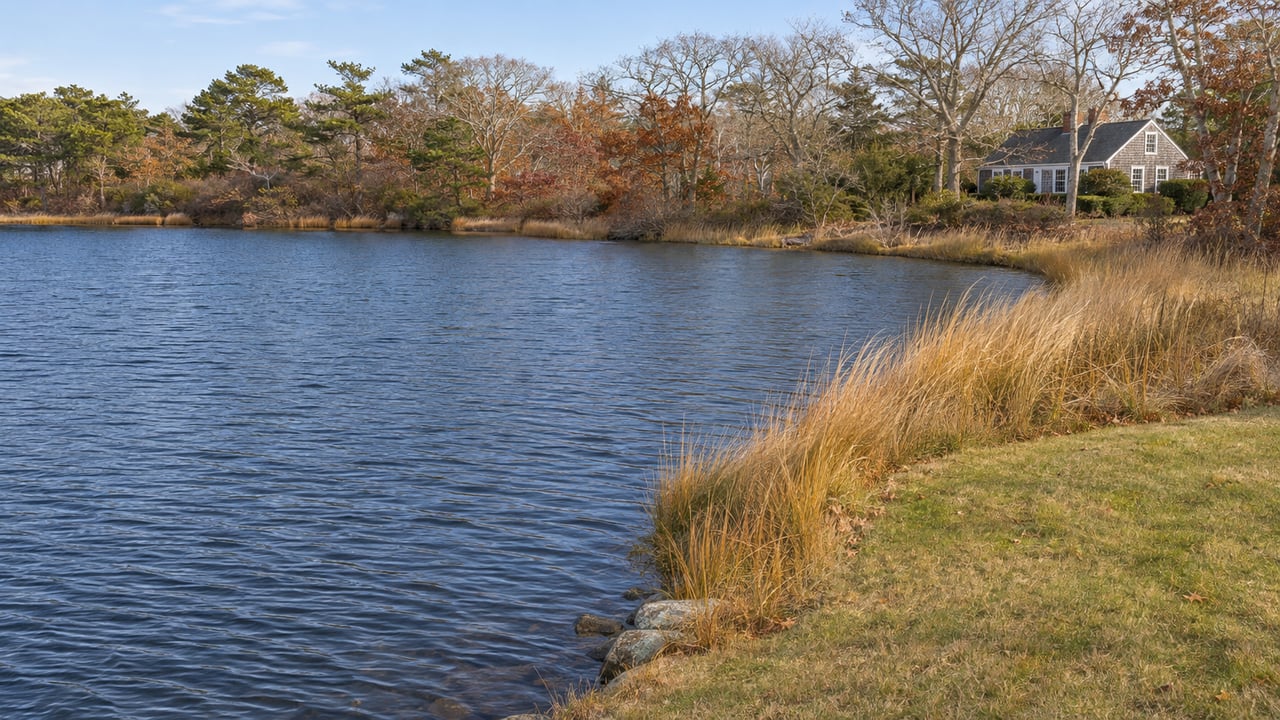
Any home sold this winter in Orleans' Phase 2 sewer area, the neighborhood around Meetinghouse Pond, carries a sewer cost with no final number. The town has not yet set the betterment for these roughly 400 properties. When it does, the calculation will start from how much water each property used in 2023, 2024 and 2025. Town officials said at an October 27 residents' meeting that the Notice of Betterment letters will likely go out around March 2027. That is close to the end of the one-year connection window, which began with the Letter to Connect the town sent on March 31, 2026.
So two sewer costs come into focus in the same season. One is the private cost of connecting the house. The other is the public assessment. A purchase agreement signed in December has to deal with both, and neither has a final number yet.
The Bill Is Calculated From Past Water Use
Orleans spreads sewer costs in "sewer units." According to the town's Sewer System FAQ, one unit equals the average daily water use of the lowest residential category in the service area. A property that uses more water gets proportionally more units, and no property gets fewer than one. The town's Meetinghouse Pond Betterment Estimator sets one unit at 125 gallons a day and asks owners to enter their water use for 2023, 2024 and 2025.
At the October 27 meeting, Water and Sewer Superintendent Sue Brown showed owners how to find that same 2023 to 2025 data in the town's "Eye on Water" system. According to the meeting notes, the Eye on Water figures match the water bills from those years exactly.
This matters most at a sale. Most of the water use behind the assessment was recorded before this winter, whoever owned the property during those years. A house that sat empty most of the year and a house that ran a full irrigation system all summer may look identical in listing photos and carry very different assessments. The FAQ says the final figures will reflect final project costs, updated water-use information and "the property's use at the time of assessment." Undeveloped lots in the area are assessed too, and the town evaluates vacant lots based on their highest use.
According to preliminary calculations presented on October 27, about 60% of Phase 2 properties will have one sewer unit and another 20% will have up to 1.5 units. That leaves roughly a fifth of the area above 1.5 units. Phase 1 shows how far the range can go. Downtown betterments started at a one-unit minimum of $5,567 and topped $100,000 at the high end.
Why the Unit Price Jumped
The preliminary Phase 2 figure is $7,900 per sewer unit. Phase 1 was $5,567. At the October 27 meeting, officials called that "a substantial jump." They said Phase 1 split its cost among about 900 properties, while Phase 2 has about 400. They also said Phase 1's total cost was much higher because it included the treatment facility and three pump stations.
Owners pay only a share of the project. Under the Select Board's policy, betterments cover 20% of each phase's cost. Notes from a February 2025 Phase 3 community meeting say Phases 1 and 2 are paid 80% on the tax rate and 20% through betterments. Voters at the May 9, 2022 Annual Town Meeting approved $32,906,000 for the Meetinghouse Pond collection system and pumping station, before grants or subsidies. The project also received a 25% subsidy through the Cape & Islands Water Protection Fund.
The interest rate is still open. Phase 1 betterments were financed at 0%. For Phase 2, the bylaw allows up to 2% above the 0% State Revolving Fund rate, and the Select Board will decide on a recommendation from the Board of Water and Sewer Commissioners. Officials described the risk of the cost figures moving "out of bounds" as "very, very low."
Here is how the preliminary unit price works out at a few usage levels, before any interest, spread over the 30-year default term:
| Average daily water use, 2023 to 2025 | Sewer units | Preliminary betterment at $7,900 per unit | Per year over 30 years at 0% |
|---|---|---|---|
| 125 gallons or less | 1.00 | $7,900 | about $263 |
| 187.5 gallons | 1.50 | $11,850 | about $395 |
| 250 gallons | 2.00 | $15,800 | about $527 |
These figures are illustrative. The town describes its estimator as "for illustrative purposes only," and the final assessment will come from final costs and the interest decision.
A Deadline and a Notice in the Same Season
The Phase 2 schedule, as the town has reported it:
| Date | What happens |
|---|---|
| March 31, 2026 | Letter to Connect sent. Owners have one year to finish installation. |
| October 22, 2026 | 94 of 374 properties, or 25%, had gone through the connection process. |
| Around March 2027 | Notice of Betterment letters expected, with each property's sewer units, betterment amount and payment options. |
| July 2027 or January 2028 | Betterments expected to first appear on property tax bills. |
Connecting is required. The FAQ says properties in the service area "are required to connect." The Board of Health can defer the connection deadline for a property with a compliant septic system, but a deferral does not cancel the betterment. The betterment is charged whether or not the property has connected.
With about three-quarters of the area still to go as of late October, a house that changes hands this winter may also be changing hands mid-project. Before construction finished, the Cape Cod Chronicle reported AECOM's Tim Harrison warning that engineers and contractors would be in high demand as the deadline got closer. "Definitely do contact your engineers early," he said.
What the Connection Itself Costs
The connection is a separate cost from the betterment. The betterment covers the public system up to the property line. It does not cover the private line from the house to the sewer stub, and it does not cover decommissioning the septic system. The town's FAQ says owners should budget for:
- A connection permit of $0.50 per gallon of average daily water use, or $250, whichever is greater
- A $75 Board of Health septic system abandonment permit
- Engineering, plans and permit application, on the order of $5,000 to $7,000
- Construction for a single-family home, including decommissioning the septic and restoring the yard, on the order of $5,000 to $30,000
Lower-lying properties may need a grinder pump to push wastewater up to the main. The Chronicle reported pump estimates of $7,000 to $15,000 depending on model and size, and noted that the town bought pumps in bulk from F.R. Mahoney, with the cost usually included in the contractor's price. The FAQ says final costs depend on the distance to the stub, depth, groundwater, ledge or boulders, and landscaping, and it encourages neighbors to get proposals together, which may bring better pricing.
How the Lien Moves at a Sale
If an owner does nothing when the Notice of Betterment arrives, the default is 30-year financing added to the quarterly tax bill, with a lien recorded at the Registry of Deeds. Owners can also pay in full, and paying off early carries no penalty.
The October 27 notes say the lien "runs with the property" until it is paid. Town Treasurer Scott Walker confirmed that legally the lien could transfer with a sale, but said that "typically these things are settled with the property closing." The FAQ says the same thing: the lien can transfer to the new owner or be paid off at transfer.
A closing between now and March falls before any lien exists. The assessment is expected, the 2023 to 2025 water records behind it are available, and a preliminary unit price is public, but there is no recorded amount to pay off at the closing table. Buyers and sellers in that window will want their attorneys to look at how the purchase agreement handles the expected assessment and any unfinished connection work. Assessor Brad Hinote said at the October meeting that it would take several years of sales data to measure how sewering affects property values in Orleans.
Where the Phase 2 Boundary Ends
Twenty-eight properties around Tides End Lane, Walker Road and Cedar Cove Road were approved by voters for Phase 2. They were left out of construction because the State Revolving Fund could not cover the expansion, and the advisory committee was considering them for Phase 4, according to the Cape Cod Chronicle. Those homes are not on the March 2027 schedule. The town's online GIS has a "Sewer Area Service Phases" layer that shows which phase any parcel falls in.
The same steps will come around again. Phase 3 is under construction along Route 28 between Finlay Road and Monument Road, with Robert B. Our Co. as contractor, and the town describes it as a multi-phase project with no fixed completion date. The town's master plan calls for about 60% of Orleans homes and businesses to be sewered across 16 phases over the next several decades.
FAQ
Does connecting early lower the betterment? No. The betterment is based on final project costs, water use and the property's use at the time of assessment, and it is charged whether or not the property has connected.
Is there help with the cost? The FAQ lists a betterment deferral for qualifying homeowners over 65, the Barnstable County AquiFund connection loan, and state tax credits, each with its own eligibility rules.
Who answers property-specific questions? John Nelson, the town's Water/Sewer Program Coordinator, at [email protected] or 508-240-3700 ext. 2319.
This post is general information about the town's published rules, not legal, tax or financial advice. Buyers and sellers should confirm how these rules apply to their own property with their attorney, lender and tax advisor.
If you own a home near Meetinghouse Pond and are thinking about listing before spring, Christa Zevitas can help you gather your water-use history, your connection status and the town's documents before buyers start asking, so your sewer details are in order when the listing goes live. Request a free home valuation to get started.